Cloud Computing
8 min read
If you work as a Frontend developer, it is natural for your focus to revolve around Components, State, and User Interface (UI) design. When you first start working with the Backend, the process may seem simple: you send a request to an API, receive data in JSON format, and then display it to the user. This can lead beginners to think that the Backend is nothing more than a URL that receives requests and returns data.
As a Frontend developer, you only see the visible part of a much larger process. Behind every request are layers of systems and protocols, authentication mechanisms, authorization checks, data management, security, and performance optimization. All of these components must work reliably and efficiently, whether the application serves a limited number of users or thousands of users at the same time.
The Backend, therefore, is not simply a Router that receives a request or a Controller that executes a database query. It is a fundamental part of the application's architecture, responsible for creating a reliable, secure, and scalable environment capable of handling data and requests efficiently.
This is where solutions that allow developers to benefit from backend services without having to build and manage every component from scratch become valuable. This is where Backend as a Service (BEaaS) comes into play.
Backend as a Service (BEaaS) is a cloud computing model that allows developers to rely on ready-made services to manage the backend components of web and mobile applications, rather than building and managing all of them within the project themselves.
A BEaaS platform provides a range of ready-to-use components and services, such as databases, user management and authentication, and API management. This allows developers to focus more on building the application and its user interface without having to develop every server component or manage the underlying physical infrastructure.
Unlike the traditional approach to backend development, which requires server setup, middleware configuration, and direct management of multiple components, BEaaS relies on APIs and Software Development Kits (SDKs) to create a connection between the Frontend and cloud services.
This model can accelerate application development and reduce the time required to launch a product. It can also reduce the effort and costs associated with infrastructure management and DevOps operations. As a result, BEaaS has become an attractive option, particularly for startups and development teams that need to build modern, scalable applications within a short period of time.
Why do we need a Backend service? Why not simply handle everything inside the browser? The question may seem reasonable given that browsers can run JavaScript and perform many operations. So why do we need a backend server in the first place? The answer begins with a fundamental principle of information security and systems engineering: the client cannot be fully trusted.
The code running on the user's device, whether in a browser or a mobile application, operates in an environment that is not under the developer's control. Users can inspect it, modify its behavior, or attempt to bypass the restrictions that have been put in place. For this reason, sensitive operations cannot rely solely on the Frontend.
For example, if deducting money from an account depended entirely on logic implemented in the Frontend, a user could attempt to manipulate the submitted value or bypass certain validation steps. When sensitive operations and their verification are handled by the server, however, the final decision is no longer controlled by the user's device.
This is where the importance of the Backend becomes clear. It performs several essential functions, including:
A Central and Trusted Source of Data: Applications with a large number of users need a Single Source of Truth. If millions of users are using the application, every instance of the application must rely on the same data when determining an account balance, the available inventory of a product, or the status of a particular order.
Protecting Secrets and Sensitive Data: Some information should never reach the user's device in the first place, such as database credentials, external service keys, payment gateway keys, encryption secrets, and certain algorithms or business rules used by the application.
Providing Computing Power: Frontend performance depends largely on the capabilities of the device being used by the client. The application may run on a powerful computer or on a smartphone with limited resources.A server, on the other hand, can be equipped with greater computing, memory, and processing resources to handle operations that require significant computational power or intensive processing, and then return the result to the application. This allows some of the heavier processing tasks to be moved away from the user's device.
From Serving Pages to Powering the Application
With the evolution of modern web applications and the emergence of Single-Page Applications (SPAs), the separation between the Frontend and backend services has become much clearer. The Frontend has taken greater responsibility for the user experience and data presentation, while the Backend manages application state, data, and Business Logic, making them accessible through APIs.
The Backend is therefore no longer simply a place where requests are sent to retrieve data. It has become a fundamental layer that controls how data is processed, how system rules are enforced, how sensitive operations are protected, and how different data sources and services are handled.

BEaaS acts as a ready-to-use infrastructure layer that connects the application's Frontend to cloud-hosted backend components through APIs and Software Development Kits (SDKs).
Instead of building server-side logic from scratch and managing it independently, developers can rely on managed services such as databases, authentication systems, and user management, and integrate them directly into the application.
In practice, this reduces the burden of setting up and manually configuring servers while allowing the Frontend to connect to backend services with significantly less code than would typically be required in a traditional architecture.
Seamless Application Integration: Backend as a Service (BEaaS) provides access to ready-to-use backend services through standardized and flexible integration methods. This helps development teams accelerate application development and deployment without having to build a complete backend infrastructure or take on the burden of operating, maintaining, and managing it.
Adding Custom Application Logic: When an application's requirements go beyond the capabilities of the available ready-made services, Serverless Functions can be used to implement business logic, process Webhooks, and integrate with external systems. The advantage of this approach is that the code runs only when needed, without requiring the developer to manage the servers that execute it.
Automatic Scaling as Usage Grows: With Backend as a Service, an increase in users or requests does not necessarily require the infrastructure to be redesigned. When traffic rises unexpectedly, the cloud infrastructure can scale automatically according to the workload, reducing the need for development teams to plan server capacity in advance or make manual infrastructure adjustments.
Certain types of applications can particularly benefit from BEaaS, either because they rely on recurring functionality that can be provided as ready-made services, or because rapid deployment is a critical factor in the project's success.
On-Demand Service Applications: From transportation and food delivery applications to various marketplace platforms—including freelancing, real estate, services, and e-commerce—this type of application typically requires separate profiles for sellers and customers, product or service listings, internal search, shopping carts, geolocation, and delivery payment processing.
Social Networks and Instant Messaging: These applications rely on user accounts and conversations that support file sharing, voice and video calls, as well as internal search based on multiple criteria—all of which can be provided by a BEaaS platform as ready-to-use services.
E-Commerce and Digital Stores: This is where advanced search, internal messaging between buyers and sellers or support services, customer reviews and feedback, and a fully integrated shopping cart with ordering and delivery options become important.
Productivity Applications: These applications include task lists, ticket creation, advanced search, and note sharing with the ability to attach files and add comments. These functions are often built using the same ready-made components provided by BEaaS.
The difference between the two approaches is not limited to development speed. It also extends to the developer's day-to-day work and the amount of effort required at each stage of building the application.
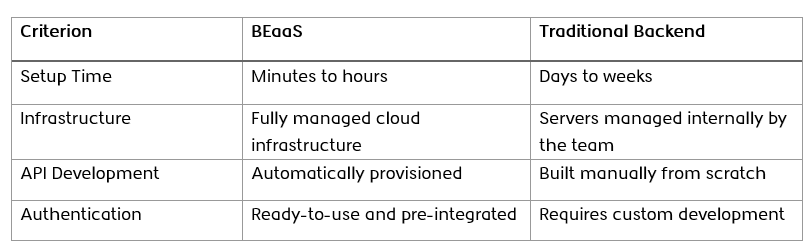
In short, BEaaS reduces the time and effort required during the initial stages, while a traditional Backend provides greater control for those who need a fully customized infrastructure.
With Sohobcom, Backend as a Service is more than just a technical concept to read about. It becomes a ready-to-use service provided by Yemen's national cloud computing operator, backed by local infrastructure with availability of up to 99.9%, enabling developers to build and launch applications with confidence, supported by a technical team and competitive pricing suitable for both startups and development teams.
Be the first to rate this article

Discover how Containers as a Service (CaaS) helps move your application from development to production with simpler deployment, more flexible management, and easier scaling—without getting buried in infrastructure details.
Firebase and Supabase give developers ready-to-use databases, authentication, storage, and other backend services. But how much of the backend can they really handle—and where does a backend developer still make the difference?

A clear guide to how a Web Application Firewall protects websites and APIs from attacks, bots, abusive behavior, data exposure, and downtime.