Cloud Computing
6 min read
Imagine starting a new application today.
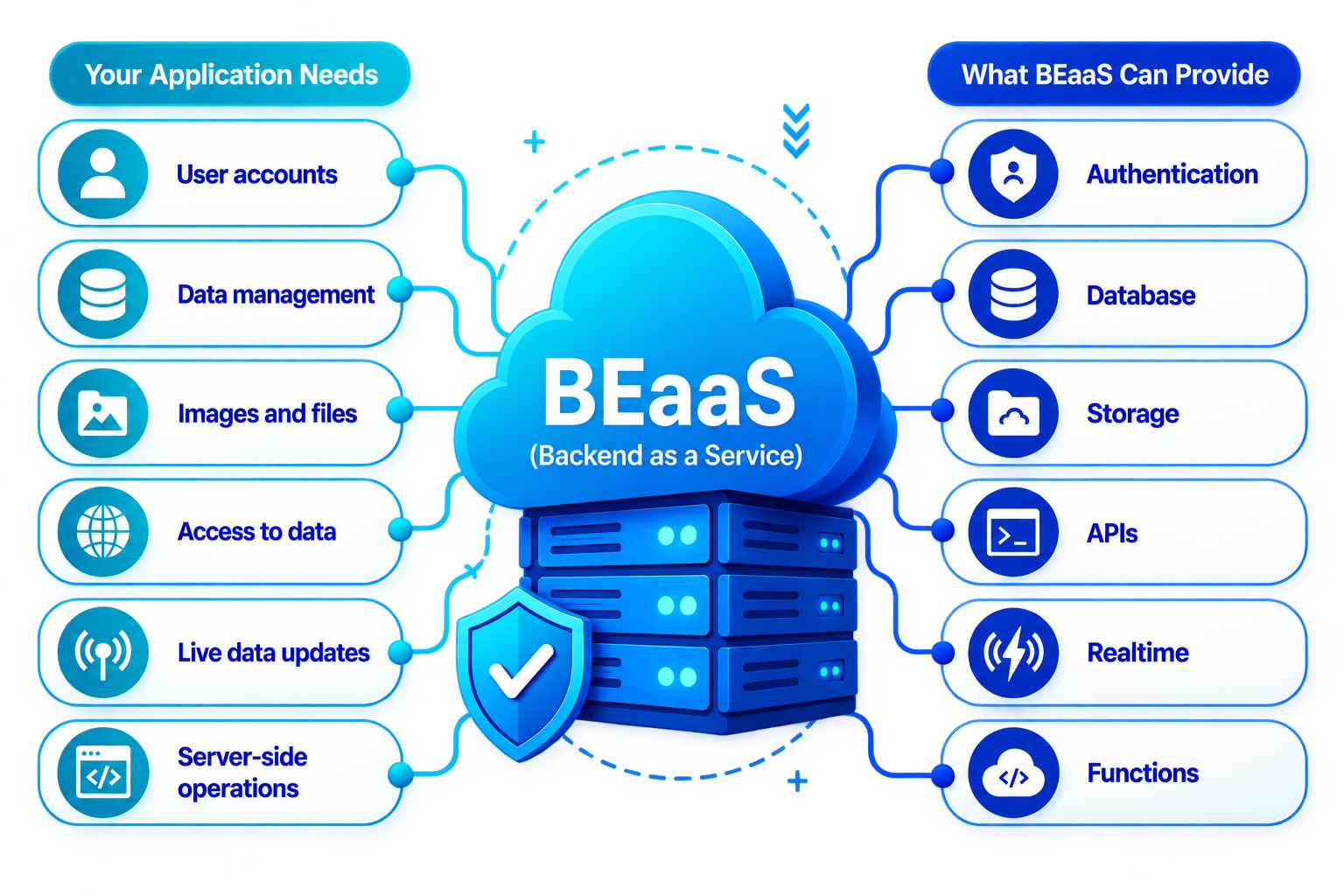
Before you even get to the feature that makes your product unique, there is an entire layer waiting behind the scenes: databases, user authentication, permissions, file storage, APIs, data security, and server-side operations.
That is the backend—the part users rarely see, but one that powers much of what they experience.
Now consider a different approach:
What if most of those building blocks were already available instead of being built from scratch?
That is exactly what platforms like Firebase and Supabase offer.
So, can we now build applications without a Backend Developer?
Not so fast.
There is more to the story.
Backend as a Service (BEaaS) is a cloud model that gives developers ready-to-use backend services that can be connected directly to an application instead of building and managing each component independently.
Popular examples include Firebase, Supabase, and Appwrite.
Supabase, for example, provides a full PostgreSQL database along with Auth for user authentication, Storage for files, Realtime capabilities, and Edge Functions for running server-side logic.
The idea is simple:
BEaaS does not remove the backend. It gives you much of the foundation upfront.
A simple “Create Account” button may look effortless to the user, but behind it are authentication, data storage, permissions, and secure communication—the exact kind of backend work platforms like Firebase and Supabase are designed to simplify.
Which leads to an obvious question:
If the platform handles all of this, what is left for a Backend Developer to do?
The answer becomes clearer when we move beyond infrastructure and look at how the product itself is supposed to work.
What Firebase and Supabase Cannot Decide for You
Imagine you are building an appointment-booking application.
The platform can provide your database, handle user authentication, and store profile images.
But it does not understand the rules of your business.
When can a customer cancel an appointment?
What happens if two people try to book the same time slot?
Who is allowed to access customer information?
How should a commission be calculated?
What happens if the booking succeeds but the payment fails?
These decisions are part of your Business Logic.
They are unique to each product, which means they still need to be designed and implemented by developers.
The same applies to data architecture, permissions, integrations, performance, security, and how the application should scale.
Firebase and Supabase can power significant parts of a backend, but they cannot make the architectural decisions that define how your system should work.
The platform provides the tools. The developer designs the system.
There is no single approach that fits every project.
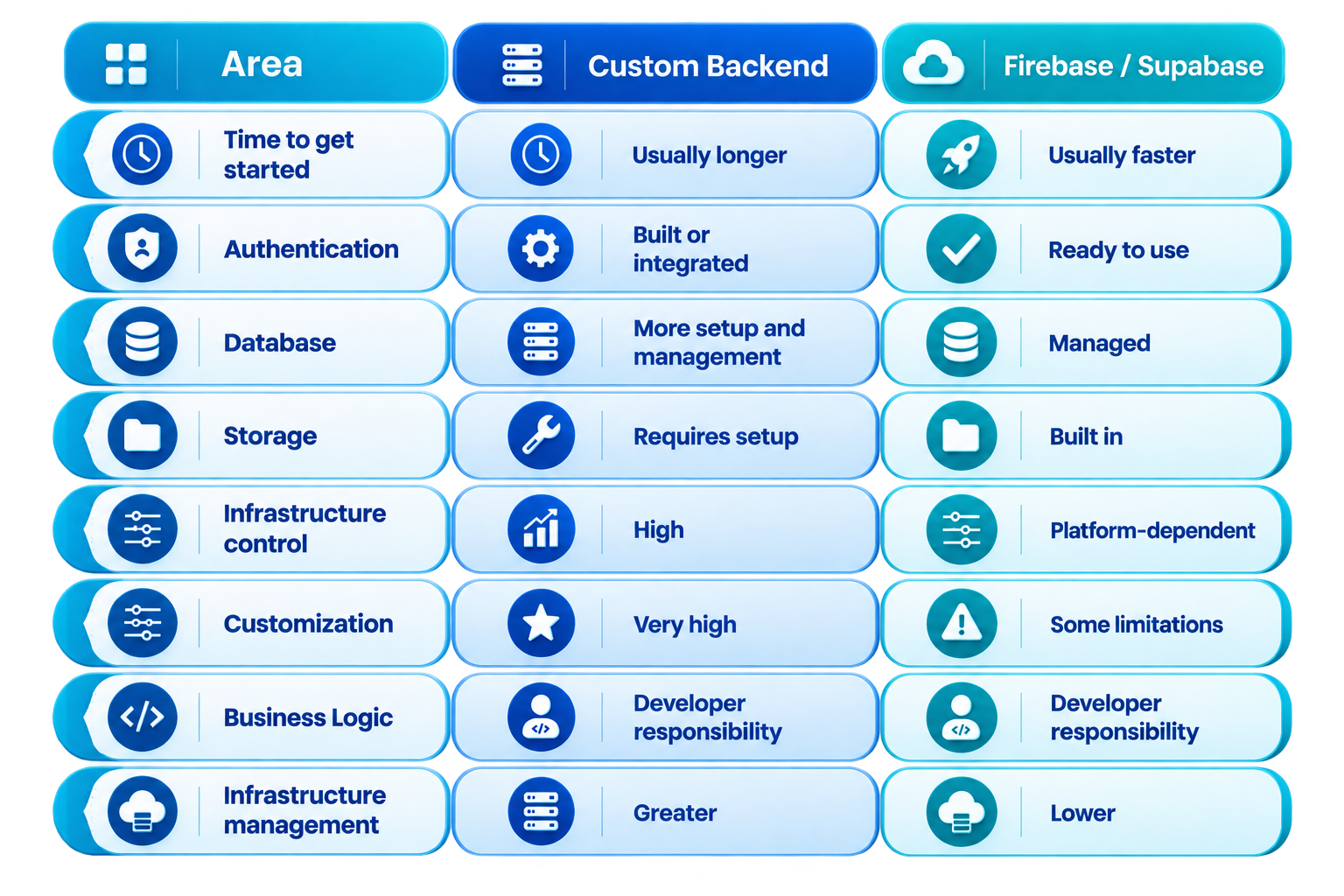
For an MVP, a small or medium-sized application, or a project being built by a lean team, Firebase or Supabase can be highly practical because they reduce the time spent setting up common backend services.
A product with complex business logic, extensive integrations, strict performance or security requirements, or a need for deeper infrastructure control may benefit more from a custom backend.
So the choice between BaaS and a custom backend is an architectural decision—not a competition over which one is universally “better.”
No.
A friendly dashboard or a button that creates a database does not remove the need to understand backend development.
Developers still need to understand databases, permissions, APIs, security, and application logic.
Supabase, for example, gives each project a full PostgreSQL database and builds services such as Auth, Storage, Realtime, and Edge Functions around it.
There is still a real backend underneath.
The difference is that much of its infrastructure is already managed and ready to use.
BaaS makes development faster. It does not make technical knowledge optional.
Built-in Authentication and permission controls do not automatically make an application secure.
A platform may provide powerful security tools, but poorly configured permissions can still expose data to the wrong users.
Developers remain responsible for defining who can access data, managing user permissions, protecting sensitive keys and information, reviewing project configurations, and ensuring that sensitive operations are handled securely on the server side.
Speed matters, but it should never come at the expense of security.
But Speed Comes With Trade-Offs
Getting started quickly with Firebase or Supabase does not guarantee that the same platform will remain the best fit at every stage of a product's growth.
As the application scales, other factors begin to matter: increasing costs, customization limits, performance requirements, and how deeply the product depends on platform-specific services.
That brings us to Vendor Lock-in.
The more your application relies on proprietary features from a single provider, the more difficult a future migration may become.
Firebase is faster, so I should use it.
Nor is it:
A custom backend gives me more control, so I should build everything myself.
A better question is:
What does my product need today—and what will it need as it grows?
So, Can Firebase and Supabase Replace a Backend Developer?
They can certainly replace some of the repetitive work developers once had to build or manage manually.
But they cannot replace backend expertise itself.
A real-world application still needs someone to determine how data should be structured, who can access it, how different services interact, what happens when something fails, how performance and security should be maintained, and how the system should scale as usage grows.
Those decisions cannot be made by clicking Create Project.
And that is the key distinction:
Firebase and Supabase do not eliminate the Backend Developer. They reduce the time spent reinventing common infrastructure, leaving more room to focus on the decisions that actually shape the product.
So perhaps the better question is no longer:
But rather:
Is this something I should be building from scratch at all?
________________________________________
Sources
Supabase Official Documentation
Reference for PostgreSQL, Auth, Storage, Realtime, and Edge Functions.
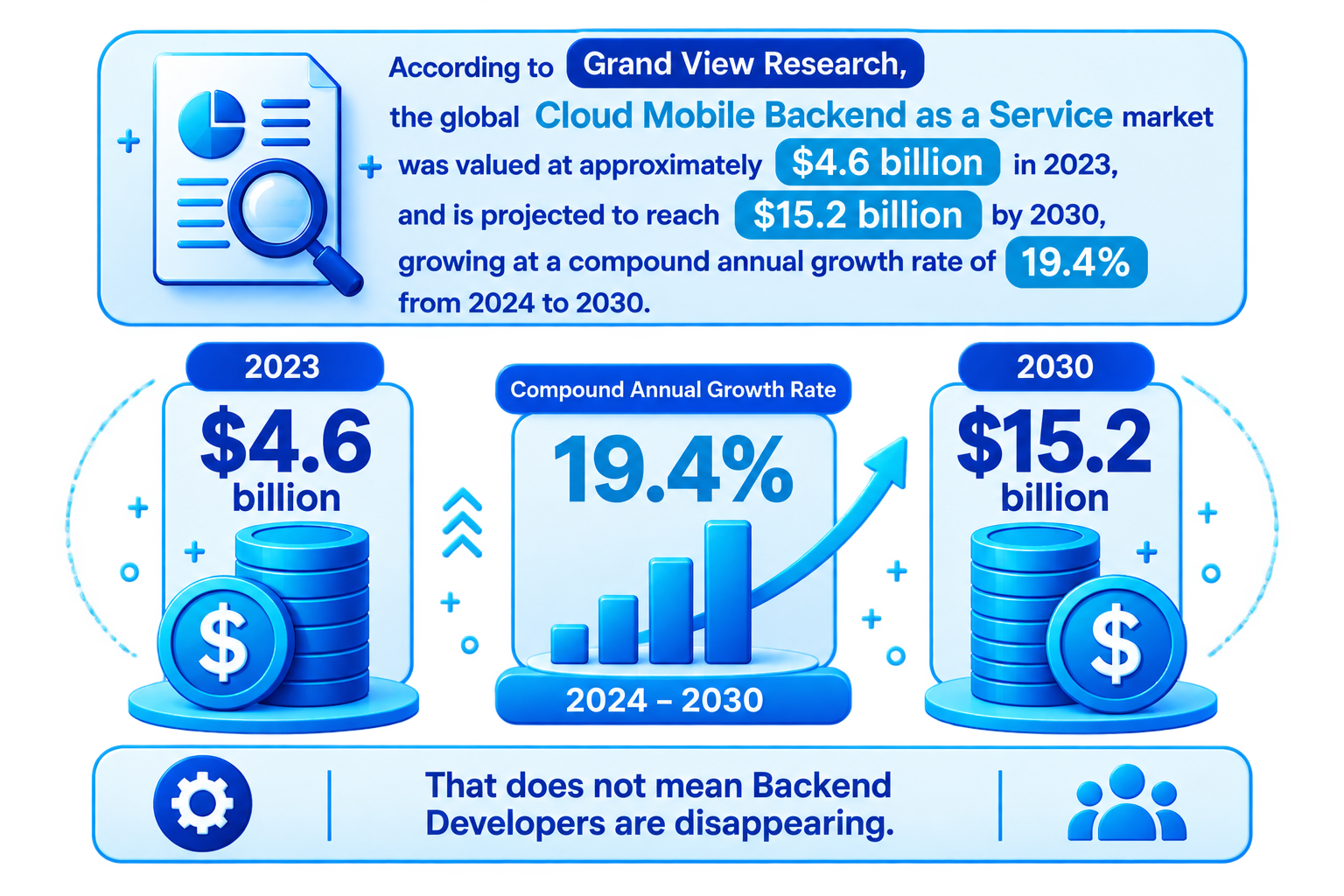
Grand View Research – Cloud Mobile Backend as a Service Market
Reference for BaaS market size and growth projections through 2030.
Be the first to rate this article

Discover how Containers as a Service (CaaS) helps move your application from development to production with simpler deployment, more flexible management, and easier scaling—without getting buried in infrastructure details.

Discover how Backend as a Service enables developers to leverage ready-to-use backend services and move from idea to application faster.

A clear, formal introduction to the Twelve-Factor App methodology—twelve engineering principles for building portable, scalable, and maintainable cloud-native applications.