Web Application Firewall (WAF)

Every public web application lives with an unusual contradiction: its front door must remain open. Customers need to sign in, submit forms, upload files, complete payments, and use digital services at any hour. Mobile applications and business partners also need to communicate with the same environment through APIs. Attackers, however, arrive through those legitimate entry points too.
From the outside, a customer and an attacker can look remarkably similar. Both may connect to the same website over HTTPS, use an approved service, and follow a network path that the organization intentionally opened. A traditional firewall may therefore see two permitted connections even though one person is checking an account while the other is manipulating input, testing stolen credentials, or automating thousands of requests.
The decisive difference is not simply who reached the website, but what they are trying to make the application do. That is the problem a Web Application Firewall (WAF) is designed to address.
What Is a Web Application Firewall?#
A Web Application Firewall is a security layer that protects websites, web applications, and APIs by examining the HTTP and HTTPS conversations exchanged with them. When positioned so that it can inspect application traffic, a WAF evaluates the context of each interaction and can allow it, log it, challenge the client, limit its rate, or block it before it reaches the protected application.
The simplest way to understand the distinction is to imagine a building. The network firewall is the outer gate: it decides which entrance may be used and which connections are allowed through. The WAF is the trained guard at the service desk: it pays attention to what each visitor is asking for and whether that request makes sense.
A network firewall protects the route to the service. A WAF protects the conversation with the application.
These controls are complementary rather than interchangeable. The network firewall remains essential, but once web traffic is permitted, the WAF provides the application-level context needed to distinguish ordinary use from suspicious behavior.
From a Connection to an Intention#
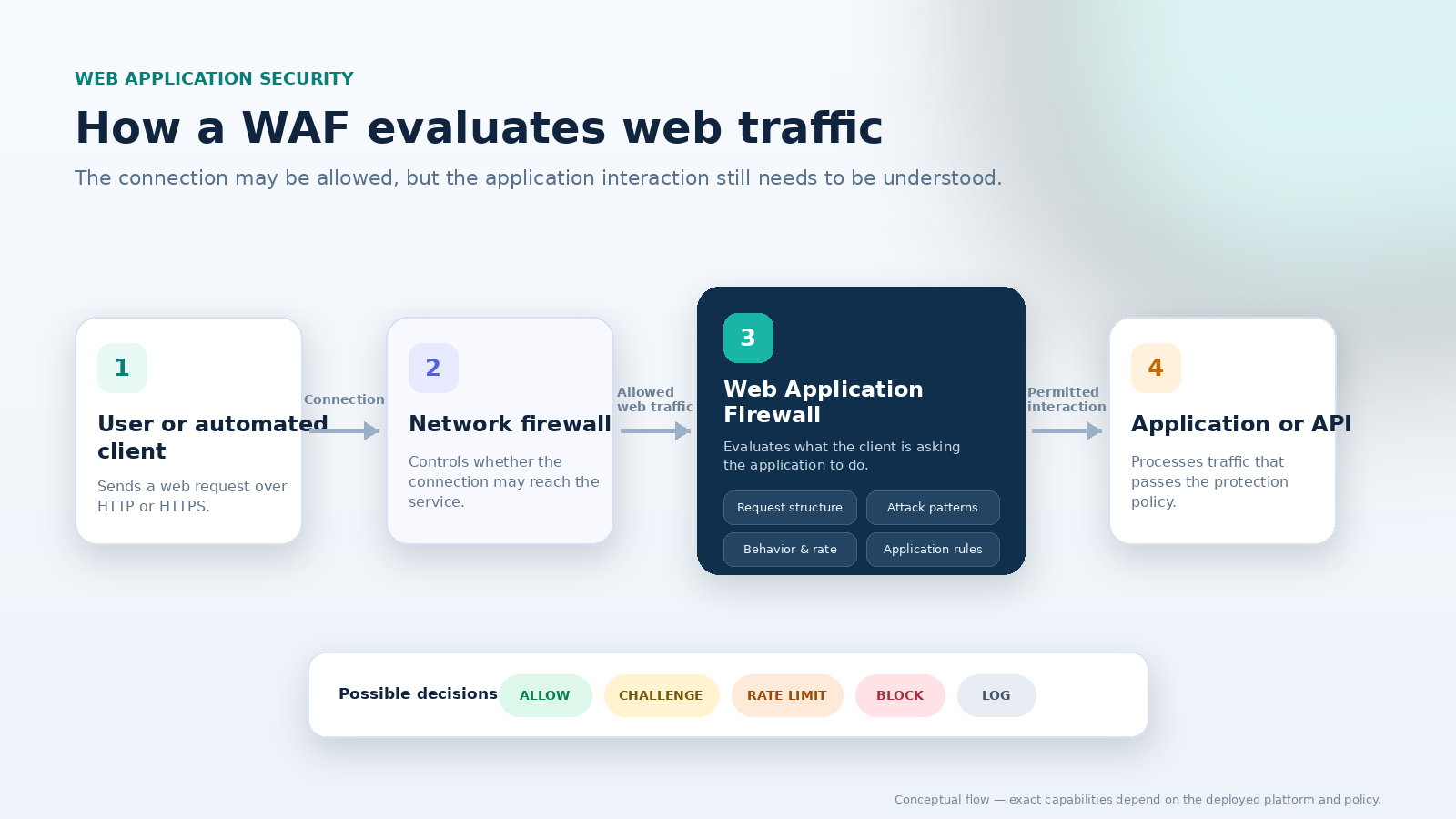
When someone clicks Sign in, the application receives far more than the words shown on the button. The underlying request identifies a destination, a method, headers, cookies, parameters, and often a body containing form data, JSON, XML, or an uploaded file. Taken together, these details describe what the client wants the application to do.
A WAF can compare that request with known attack patterns, HTTP standards, and the behavior expected by the protected application. It may consider whether a value is unusually long, whether a request uses an unexpected method, whether an upload matches its claimed file type, whether the same client is repeating an action at an abnormal rate, or whether a sequence of otherwise valid requests forms a suspicious pattern.
Context is what gives those observations meaning. A quotation mark may be harmless in a name but suspicious inside a numeric identifier. One failed login is routine; hundreds of attempts across many accounts may indicate that stolen credentials are being tested. A valid file extension says little if the content inside the file is malicious.
This is why application security cannot be reduced to searching for a few dangerous words. The more useful question is: Does this interaction make sense for this application, this user, and this moment?
How Does a WAF Decide?#
No single detection method can recognize every web attack, so mature WAF protection combines several forms of evidence. Attack signatures identify characteristics associated with known techniques such as SQL injection or cross-site scripting. Protocol validation looks for malformed requests, conflicting headers, invalid encodings, excessive sizes, and other behavior that does not follow normal HTTP expectations.
The WAF can also apply rules based on what the application is supposed to accept. This is sometimes called a positive security model: instead of asking only whether input resembles a known attack, the control asks whether it matches the permitted method, structure, type, length, or value for that part of the application. A field designed for a small number should not behave like a rich-text editor, and an API built to receive a defined JSON structure should not silently accept anything a client sends.
Reputation and behavioral signals add another layer. The source may be associated with scanning or abusive automation, while the frequency and sequence of requests may reveal activity that no single request could expose. Some platforms add anomaly detection or machine learning to identify significant departures from learned traffic patterns. These techniques can improve detection, but they are evidence—not magic—and still require sound policies, monitoring, and tuning.
One Open Door, Many Forms of Attack#
SQL injection and cross-site scripting are the best-known examples of web attacks, but they represent only part of the problem. Modern applications can be targeted through their data, paths, files, authentication flows, APIs, automated clients, responses, and browser-side components.
When Data Becomes an Instruction#
An injection attack occurs when information that should be treated as data is interpreted as an instruction by another component. SQL injection targets database queries, while command, code, LDAP, XPath, XML, and server-side template injection target other interpreters. A WAF can detect many recognizable patterns, normalize encoded input, and enforce expectations around where particular values are allowed.
Cross-Site Scripting (XSS) follows a related idea but targets the browser. The attacker attempts to introduce executable content where the application expected ordinary text, potentially affecting users who later view the page. WAF inspection can reduce many common XSS attempts, but secure output encoding and safe application design remain the primary correction.
When Paths and Files Become Shortcuts#
Applications often receive filenames, document references, or resource paths. By manipulating those values, an attacker may attempt path traversal, local or remote file inclusion, or access to resources that were never intended to be public. The danger lies not merely in an unusual character but in the location the application may reach as a result.
Uploads create a related risk because a file may later be stored, parsed, displayed, or executed. A document with an innocent name can contain malicious content, and a script disguised as another file type may become a web shell that gives an attacker persistent control. Depending on the platform and its integrations, protection may include restrictions on size and type, content inspection, malware detection, or web-shell indicators. Those controls should support—not replace—secure storage, isolation, and server-side validation.
When Normal Requests Become Abuse#
Some of the most damaging activity contains no exploit code at all. Brute-force attacks, password spraying, and credential stuffing use the same login function as a real customer. Scrapers request the same pages as a browser, and fake-account tools submit the same registration form as a new user. The malicious intent emerges through automation, repetition, timing, source reputation, and the broader pattern of behavior.
This is also how application-layer denial-of-service attacks can hide inside legitimate functionality. An attacker may flood a search page, repeatedly invoke an expensive report, hold connections open, or distribute requests across many sources. Rate controls, client tracking, reputation, and behavioral analysis can help preserve availability without treating every rise in traffic as an attack.
The goal is not simply to block machines. Search engines, monitoring systems, and business integrations are automated too. The goal is to distinguish useful automation from abusive automation.
When APIs Expand the Surface#
Modern digital services increasingly expose APIs to websites, mobile applications, partners, and internal systems. Their requests may contain structured JSON or XML, so effective inspection must understand methods, paths, content types, schemas, parameters, and value constraints rather than treating the entire message as an undifferentiated block of text.
Some modern platforms can discover APIs, validate requests against an OpenAPI definition, learn expected parameter behavior, and protect technologies such as GraphQL or WebSocket. Yet a technically perfect request can still be unauthorized. An authenticated customer may submit a valid request for another customer’s record, and no signature can automatically understand every business relationship behind that decision. The application must still enforce object- and function-level authorization.
This distinction is reflected in the OWASP API Security Top 10, which includes broken authorization, broken authentication, unrestricted resource consumption, sensitive-business-flow abuse, server-side request forgery, and inventory failures. A WAF can reduce parts of this exposure, but API security ultimately depends on controls inside and around the application.
When the Request Looks Safe but the Response Is Not#
Consider a visitor who requests an ordinary public page. Nothing in the request appears malicious, but an unexpected application error causes the response to reveal an internal file path, a database message, debugging details, a stack trace, or sensitive personal information. In this case, the immediate danger is not what entered the application; it is what the application attempted to send back.
Where response inspection is supported and enabled, a WAF may identify information-disclosure patterns, block or mask the response, and alert the security team. The protection can prevent immediate exposure, but it does not repair the application error that produced the data. Developers still need to correct exception handling and remove sensitive information from user-facing responses.
A WAF alert describes what the control observed; it does not always prove that the incoming request itself was malicious.
That lesson matters during incident analysis. Security teams should determine whether an event was triggered by the request, the response, the client’s behavior, or a combination of signals before deciding what must be fixed.
From WAF to Broader Application Protection#
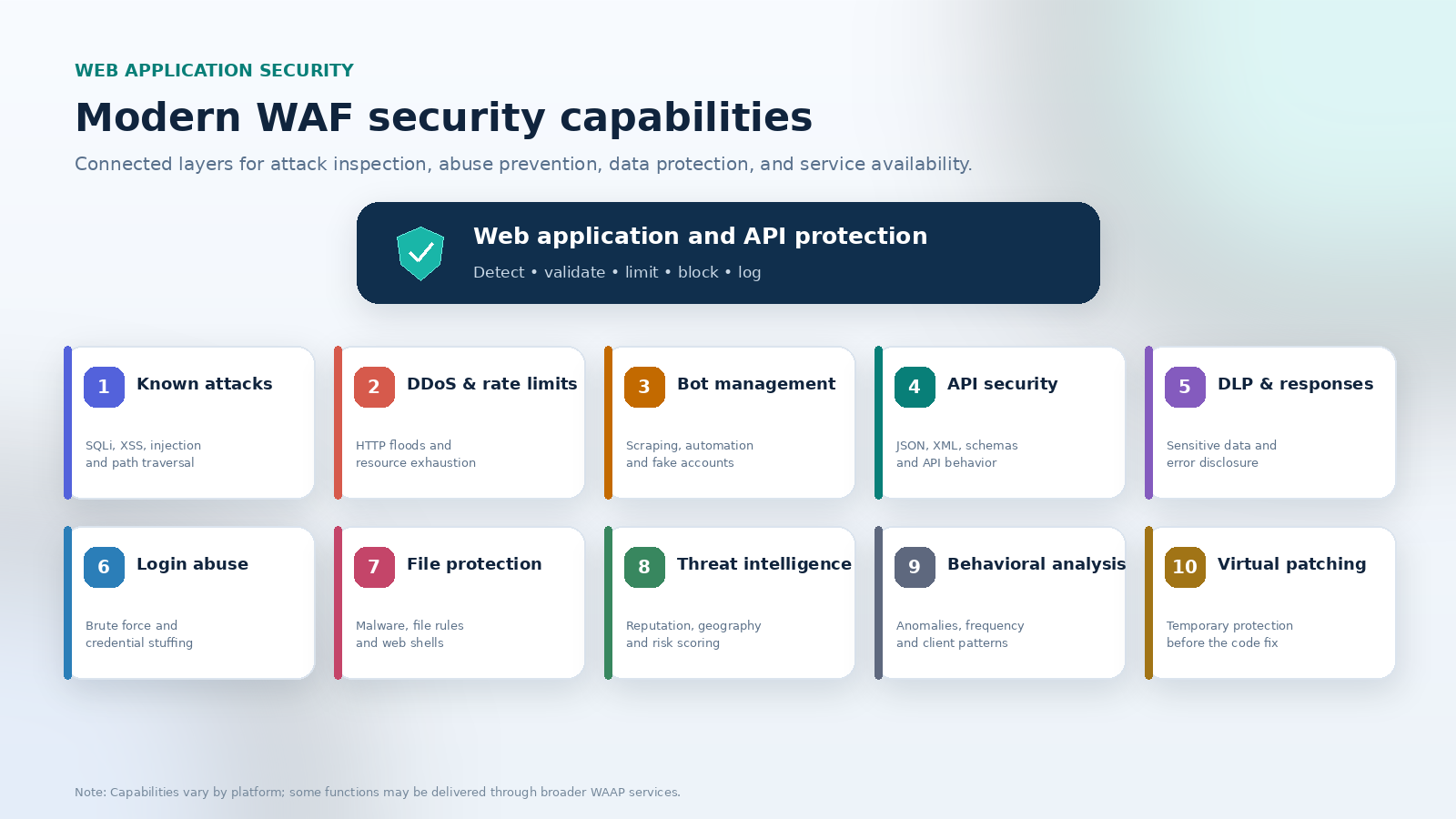
The term WAF is sometimes used loosely for a much wider collection of capabilities. A classical WAF focuses on inspecting HTTP traffic and enforcing application-layer rules. Modern security platforms may package that function with API discovery and schema validation, bot management, application-layer DDoS protection, threat intelligence, file analysis, sensitive-data controls, and client-side monitoring. This broader approach is often called Web Application and API Protection (WAAP).
The distinction is important because no organization should assume that every product bearing the WAF label includes the same protection. API security may require explicit schema definitions; bot management may rely on additional client signals; malware analysis may need a separate engine; and browser-side script monitoring is different from inspecting traffic at the server edge. Good security begins by understanding which capabilities are actually enabled, what traffic they can see, and what outcome each control produces.
The browser deserves special attention. Modern pages routinely load code from analytics services, payment providers, support tools, advertising systems, and content-delivery networks. A compromised third-party script may steal data or alter a transaction even when the application server itself has not been breached. Some broader application-protection platforms add controls such as script inventory, Content Security Policy management, Subresource Integrity support, or browser-side monitoring, but these should not be attributed automatically to every WAF.
Accuracy Matters More Than Aggressiveness#
Web applications are not uniform. A content-management system may legitimately accept HTML, a search function may receive technical expressions, and an API may use long encoded values that would look suspicious elsewhere. A generic rule cannot understand every business process without context.
When legitimate activity is classified as malicious, the result is a false positive. When malicious activity is accepted, it is a false negative. Raising sensitivity may catch more suspicious traffic but can also interrupt customers; lowering it may improve compatibility while creating blind spots. The right objective is therefore not maximum blocking but accurate protection with a clear operational response.
Effective deployment normally involves observing traffic, establishing a baseline, tuning rules to the application, testing changes, and monitoring the result. Applications also evolve: releases add features, APIs gain parameters, authentication flows change, and third-party services come and go. WAF policy must evolve with them. As OWASP’s WAF overview notes, application-specific customization can require significant effort and must be maintained as the application changes.
A WAF is not an appliance to install and forget; it is a security control attached to a living application.
Virtual Patching: Protection While the Real Fix Is Prepared#
Security teams do not always have the luxury of fixing a newly discovered vulnerability the moment it becomes known. The affected application may require code changes, regression testing, a maintenance window, or a patch that a third-party vendor has not yet released. During that period, the vulnerability still exists, and an Internet-facing application may remain exposed to exploitation attempts.
If the exploitation technique can be recognized in transit, a WAF rule may provide a temporary compensating control by stopping matching requests before they reach the vulnerable component. This approach is known as virtual patching. It can reduce the window of exposure and give the organization time to develop, test, and deploy the permanent correction safely.
Virtual patching should never be confused with remediation. The vulnerable code remains in place until the software is corrected, updated, or redesigned, and the temporary rule must itself be tested and monitored. The OWASP Virtual Patching Cheat Sheet treats code-level correction and virtual patching as complementary activities rather than competing choices.
A virtual patch buys time; the real patch removes the vulnerability.
What a WAF Cannot Solve#
The growing range of WAF and WAAP capabilities can create a dangerous misconception: that enough protection in front of an application can make weaknesses inside it irrelevant. It cannot. A WAF does not replace secure design, input handling, authentication, authorization, encryption, dependency management, patching, code review, security testing, logging, monitoring, or incident response.
Broken access control is a simple example. If an application incorrectly allows one authenticated customer to read another customer’s information, the request may use the right method, contain valid data, and follow the expected schema. The WAF may see nothing structurally abnormal because the application alone understands which customer owns which record.
The OWASP Top 10:2025 reflects this wider reality. Its risks include broken access control, security misconfiguration, software supply-chain failures, cryptographic failures, injection, insecure design, authentication failures, integrity failures, inadequate logging and alerting, and mishandling of exceptional conditions. A WAF can mitigate parts of several categories, but many require correction in architecture, code, identity controls, operational processes, or the software supply chain.
The mature view is therefore defense in depth. The WAF adds inspection, enforcement, visibility, and time for response at a strategically important point, while the application and its surrounding systems remain responsible for the controls only they can enforce.
The Real Value of a WAF#
The value of a Web Application Firewall is not that it makes a public application invulnerable. Its value is that it can see the moment when an allowed connection becomes suspicious application behavior: when submitted data starts to resemble an instruction, when one login becomes a credential-stuffing campaign, when an upload becomes a foothold, when an API call violates its expected structure, or when a harmless request causes a dangerous response.
Every Internet-facing application must keep a door open. The security challenge is to understand what happens after someone walks through it. A network firewall decides whether the route is available; secure development determines how the application should behave; identity controls determine what a user may do; and the WAF examines the conversation taking place at the door.
That is why a permitted connection should never be mistaken for a trusted interaction—and why the Web Application Firewall remains an important layer in modern application security.
Further Reading#
Rate this article
Be the first to rate this article
Comments & Discussion0
Related articles
Between NGFW and Web Applications: Why Do We Actually Need a WAF in Production?  أمن السحابة والامتثال
Between NGFW and Web Applications: Why Do We Actually Need a WAF in Production?
A practical engineering perspective illustrating the core difference between traditional firewalls and WAFs, explaining why Layer 4 protection and NGFWs fall short in securing web applications and APIs, alongside a practical review of deployment models and false positive challenges.
Emad Al-Hadheri